Tampilkan postingan dengan label photos. Tampilkan semua postingan

Selasa, 21 Januari 2014

Jeep Ski Area


Everyone knows that the most capable vehicle in the ski area parking lot is a Jeep Wrangler, so naturally lots of skiers' choose to own a Jeep.  Having a bit of fun with this association, Jeep has created a new print ad shown above that links skiing and Jeeping.

Senin, 20 Januari 2014

Gorilla Wheel Locks


Okay, I admit - it's hard to get excited about lug nuts.  But if you've never given yours a second thought, I'm here to suggest that maybe you ought to.

Besides a lift kit, what's the most expensive thing you put on your Jeep?  For most people, it's the wheels and tires!  They can easily cost well over $1,500, and if you're simply reusing the original lug nuts, those wheels and tires can be stolen in under 10 minutes.

Most wheel lock kits come with a single locking lug nut.  You can buy wheel lock lug nuts direct from Mopar, or the typical Jeep lug nut kit includes 4 wheel locks, one for each wheel.  These are easily defeated with a wheel lock removal tool, however, and don't include a lock for your spare wheel.

Gorilla Automotive makes a full wheel lock kit listed for Jeeps that includes locking lug nuts for all 5 lugs, but the problem is that it only includes 20 lug nuts; it leaves your spare tire as vulnerable to theft as ever.  The trick is to order a set for 6-lug wheels instead of for 5-lug wheels: this gives you 24 locking lug nuts so you have 3 left over for use on your spare wheel, with one extra for if you ever lose or strip the threads on one.  Single wheel lock lug nuts deter casual thieves, but a complete set of locking lug nuts installed on every single lug substantially increases the time and effort required to steal your wheels & tires, so only the most determined thief would even consider targeting your Jeep.


Gorilla Automotive part number 71684N pictured above is what I ordered, and I found yet again that Amazon.com had the best price.  It includes five 1/2-inch locking lug nuts for each wheel, plus three more for the spare tire, one extra lug nut, and the wheel lock key (special socket).  Not pictured (because I don't need anyone stealing my wheels & tires) is a sticker with the lock's part number so you can order a replacement if you ever lose the lock.  The sticker should be placed inside the glovebox or under the hood, and the wheel lock key should be kept with the Jeep at all times for when you need to install your spare tire.


The new lug nuts are the same "acorn" style as the originals, but they are slightly longer and stick out a tiny bit more than the originals.  The original Jeep lug nuts use a 19mm socket while the new wheel lock key is 13/16" or 21mm.  This means that your Jeep's tire iron will not fit your new wheel lock key.  You should already have a 13/16" or 21mm socket in your tool kit that you carry in your Jeep at all times (right???) but if you don't then it's a good idea to get a Gorilla Telescoping Lug Wrench Set that includes two sockets with all four of the popular lug nut sizes - you never know when you'll need to help a fellow 4wheeler on the trail or a damsel in distress on the side of the road, so having this powerful and compact lug wrench stored with your jack in the back of your Jeep is wise.

Minggu, 12 Januari 2014

Product Reivew: Rugged Ridge XHD Hood Catches

Rugged Ridge's black aluminum XHD Hood Catches

There's no such thing as a perfect vehicle.  The Jeep Wrangler JK is about as close as you'll ever find, but even it has its shortcomings.  For instance, its suspension is too low.  It doesn't come from the factory with 35-inch-tall tires.  And its rubber hood catches allow the hood to flutter in a strong headwind.

Most serious Jeep owners install a suspension lift kit and bigger tires, but not enough of them upgrade their hood latches.  When new, the original rubber hood latches work fine, but as the rubber dries out and they lose their elasticity with age, they can allow hood flutter when traveling at a high rate of speed.  Even at normal highway speeds, a strong headwind or an oncoming truck can blast enough wind through the Jeep's radiator to pressurize the underhood engine compartment and force the hood to lift.

The original plastic and rubber hood catches

It may be disconcerting to watch the hood bounce up and down with every big gust of headwind, but the hood isn't going to fly open all of a sudden; not only would both rubber hood catches need to break, but the central metal hood latch would also have to fail.  But even so, I wanted to upgrade my Jeep's hood catches to solve this annoyance.

There are a few aftermarket upgrades available for the JK, TJ, and earlier Jeeps.  The most popular is the Daystar Hood Wranglers.  These are a pair of polyurethane replacement straps for the original rubber straps.  They don't stretch as much as the rubber ones do, and the polyurethane is reported to better withstand weather and ultraviolet breakdown over the years.  They're very easy to install and at only $25 a set, it would be silly to replace your worn out old rubber ones with a set of fresh rubber ones from your local Jeep dealership.


Daystar Hood Wranglers

The downside to Daystar's Hood Wranglers is that they still utilize the OEM plastic latch, mount, and buckle pieces.  Since plastic breaks down and becomes brittle in the sun, and also succumbs to general fatigue, I wanted to find a better option.  After lots of research, I chose the Rugged Ridge XHD Hood Catches which dwarf the OEM hood catches, are proven to be a huge upgrade in strength and durability, and are surprisingly affordable.


Every part of these extra-heavy-duty hood catches is metal.  Rather than simply utilizing a flexible material for the strap, these hood catches have a fully adjustable turnbuckle with jam nuts to allow simple adjustment and prevent them from coming loose.  The billet aluminum hardware is powdercoated black, but they are also available in silver, which not only doesn't match anything on the Jeep but are also more expensive.

OEM Jeep hood catches next to Rugged Ridge's XHD upgrade

Everything you need is included in the box:

Clear instructions and quality packaging

Installation is very easy - remove the original hood catches and install the XHD Hood Catches in their place:

Re-use the rubber hood bumper on the new base bracket
The bottom bracket has one supplied nut, countersunk bolt, and washer.  It utilizes two alignment pins, just like the original bracket.  Getting a 1/4-inch ratchet with a 1/2-inch deep socket behind the fender is the trickiest part of the entire installation.

Easily accessible nuts for the hood latch
The hood-mounted upper bracket is easily removed and replaced since the two 10mm nuts are readily accessible on the underside of the hood.  New bolts, washers, and nuts are supplied in the Rugged Ridge kit.

After loosening the jam nuts, rotating the buckle to adjust its length and tension, and retightening the jam nuts, the new Rugged Ridge XHD Hood Catches secure the hood down with a solid, reassuring clunk.  There is no way the billet aluminum and stainless steel hardware will stretch or crack like the original rubber and plastic parts do, and hood flutter is a thing of the past.  The oversize and attractively-styled XHD Hood Catches give the Jeep a subtle yet powerful visual upgrade that won't look weathered and worn out after a few years in the sun.


Rugged Ridge has a lot of dealers so you shouldn't have any trouble sourcing this kit, but pricing varies considerably.  The kit retails for $130.99 but the best price I found is on Amazon.com where you can also read numerous glowing reviews from other Jeep owners.  I paid around $78.00 and I consider it money well spent.

Sabtu, 11 Januari 2014

The Story of "Stomper" The Rescue Rubicon


A silver lining has emerged from the black cloud of the devastating tornado that destroyed Moore, Oklahoma on May 20, 2013.  The story of Bryan Hutton and his 2012 Jeep Wrangler Rubicon "Stomper" begins with them leaving their home on Ohio to visit family in Oklahoma.


They got caught in the tornado's path.  Their Jeep was locked in the garage while the family hid in their storm cellar.  Once they emerged after the tornado passed, they found nothing left of their neighborhood.  The Jeep was buried in what was left of the house.


Hutton started checking other homes for survivors and soon realized that the Jeep could be very useful in rescuing people from the rubble - if it could start up and drive.  He dug through the rubble and was able to get the driver’s door open just enough that he could reach in and push the clutch pedal in with his hand and then turn on the ignition.  The Rubicon fired right up.  He reached in and jerked the shifter into reverse.  The Rubi begin to dig and claw its way backwards out of the debris and out of the garage.  Once it cleared the debris he was able to get it stopped in the driveway.


He cleared the wood and other debris out of the Jeep and drove up and down the neighborhood on three flat tires, offering help in any way he could.  He used the Jeep's Warn VR8000 winch numerous times to uncover people trapped under debris.  He transported injured people to medical personnel.  He delivered food, water, clothing, and other supplies to people.

The hero Jeep, although a total loss as far as insurance is concerned, is not heading to the recyclers.  Inspired by Bryan's efforts and the never-say-die attitude of his Jeep, numerous Jeep aftermarket  companies are contributing to its rebuild, including ARB, Reid Racing, Warn, TeraFlex, Rock Krawler, MetalCloak, Rock-Slide Engineering, Rugged Ridge, DiabloSport, Asfir4x4, TrekArmor, GR8TOPS, Genesis Offroad, RCV Performance, Factor 55, TrailReady, Burnsville Offroad, Race Car Dynamics, and others.  The rebuild is being performed by Crocker Off Road Performance in Phoenix, AZ.

You can follow the story and connect with everyone involved on the Jeep's Facebook page.  Several news outlets are also covering this story, including Jalopnik, Truck Trend, Highline Autos, and C4x4 Magazine.


Here's a great video from RightThisMinute.

The 4x4 Podcast discussed the whole story of Stomper.

Stomper even inspired a Jeep commercial:


Minggu, 05 Januari 2014

President Reagan's Jeep CJ-6 and CJ-8 Scrambler

Real men drive Jeeps

President Ronald Reagan was many things: a lifeguard credited with saving 77 people, a sporting goods salesman, a college football player, a U.S. Cavalry officer, a Hollywood actor, a television spokesman, California's Governor from 1967-1975, and the 40th President of the United States of America from 1981-1989.  Most famous for his Presidency, his Libertarian views and economic policy helped pull us out of a depression and into a 25-year economic boom.  He drove liberals nuts, and to this day he's the kind of leader whom conservatives wish they could find again.  His steadfast leadership as President helped us win the Cold War and avert nuclear war.  Ronald Reagan was a man's man.

What sort of vehicle would such a man drive?  Not just one, but two Jeeps.

Reagan's 1962 Jeep CJ-6
Reagan's 1983 Jeep CJ-8 Scrambler


In 1974, Ronald and his wife Nancy bought a 688-acre ranch in Southern California named Rancho del Cielo to use as a peaceful getaway from the stress of the political world.  Unlike our current pampered President with his dozens of aides and even a $102,000/year salaried dog walker, Reagan was a tough outdoorsman who wasn't afraid of doing a little hard work himself, so to assist him on the ranch chores he purchased a 1962 Jeep CJ-6.


The CJ-6 lived a hard life, but its 134-cubic-inch 72hp F-Head inline-4 and T-90 three-speed reliably put power to the Spicer 18 transfer case, Ramsey PT1J dual-output PTO gearbox, Ramsey 8,000lb PTO winch, and Dana 25/44 axles.


Reagan didn't just use his Jeep for photo ops; the dirt and dents illustrate the life of a hard-working Jeep and a hard-working owner.  What better way to recharge one's batteries than to get away from the political zoo by spending some time getting back to nature on your own ranch?  Reagan once said of Rancho del Cielo:
"No place before or since has ever given Nancy and me the joy and serenity it does."
In 1983, Nancy Reagan purchased a new Jeep for Ronald, a 1983 Jeep CJ-8 Scrambler Renegade:


The Reagans' Scrambler was powered by the 4.2-liter inline-6 with the Borg-Warner SR-4 four-speed manual transmission.  Power was split by the Dana 300 transfer case to a set of wide-track Dana 30 and AMC 20 axles.


Although Jeep designed and marketed the CJ-8 as a hard-working utility truck, Reagan seems to have preferred to treat his kindly and reserve the hard work for the trusty old CJ-6.


The Reagans used the Scrambler as more of an offroad shuttle for visitors to their ranch, the most famous of whom was the Soviet Union's President Mikhail Gorbachev.  Could a ride in this Jeep, a visit to this paradise, and some quality time together outside of the political world have helped these two opponents whose countries were on the verge of nuclear war resolve their differences and achieve societal prosperity?  I like to think so.


Ronald and Nancy Reagan last visited their ranch in 1995.  With President Reagan's advancing age and declining health, they decided to donate the Jeeps and sell the ranch to the Young America's Foundation which today preserves Rancho del Cielo as a living monument to Reagan's ideals and values.  While both of the Jeeps continue to live at the ranch, only the Scrambler is on public display; the beat-up old CJ-6 lives in the tack barn with the chain saws, mowers, and other tools of the ranch.

JP Magazine, which is the world's top Jeep-specific magazine, managed to get a special look at the Reagans' two Jeeps a few years ago.  You can read the article republished here on their website.  If you want to learn more about the Reagan Ranch or visit the President's Jeeps yourself, head over to the Young America's Foundation.


Inside the Jeep Wrangler Assembly Plant


Jeep's Toledo South Assembly Plant is a busy place, cranking out Jeep Wrangler JKs as fast as possible.  So many, in fact, that they recently celebrated the One Millionth JK Wrangler.  This short video gives a look inside the modern Ohio assembly facility at the seamless blend of high-tech robotics and good old-fashioned American labor:


Selasa, 31 Desember 2013

The Jeep Wave


The Jeep Wave is a sacred tradition amongst Jeep owners, carried down through the generations from its origin with our military servicemen.  Camaraderie amongst soldiers carried over to civilian Jeep owners after the war, and as the respect and mystique surrounding the Jeep brand grew over the years, Jeep owners became a prouder bunch.


Since the very beginning, Jeep owners have been a breed apart from typical motorists.  Jeeps are driven by people who care about more than just a comfy ride and ergonomic controls; Jeeps are about fun, durability, and individuality.  Jeeps aren't just transportation appliances, they're toys.  We recognize other Jeep owners as members of an informal club of cool kids - when we see another Jeep coming our way, we can be pretty certain that its driver is someone with whom we'd get along well.  Hence, the Jeep Wave.


As the popularity of Jeeps and the vehicles they inspired has grown, the Jeep Wave has expanded to include other worthy offroad vehicles.


Before I became a Jeep owner, I built several very trailworthy Suzukis, Toyotas, and military vehicles.  I have always waved at well-built 4x4s, but now that I'm a Jeep owner, I wave at every Jeep I pass no matter how modified it is.  Sure, soccer moms aren't very likely to wave back, but that's not the point.

This YouTube video caught my attention as it discusses the Jeep Wave:


Not all offroaders drive Jeeps, but all offroaders are Jeepers who share the love and appreciation for our sport and the wonderful people who partake in it.  When you pass a nice 4x4, shoot your hand out the window and flash a smile - you never know whose day you'll make! 


Minggu, 08 Desember 2013

Brazilian Jeep Wrangler - the Troller T4

The Troller T4 is a Brazilian-made offroad vehicle "inspired by" the Jeep TJ and JK Wrangler.  It is a fiberglass-bodied, turbodiesel-powered, Dana-axled jeep that fills a giant void that Jeep themselves have left wide-open in the Brazilian market.


Before you dismiss this vehicle as nothing more than a cheap wanna-be like the notoriously crappy Chinese knockoffs, you should understand that the Brazilian market demands tough vehicles.  The T4 is built with solid components, engineered for extreme offroad abuse, can be upgraded with offroad equipment such as lockers and lift kits, and has competed in the Dakar Rally.  The Troller T4 may not be the real deal, but it's a worthy Jeep replacement nonetheless.

Ford of Brazil seemed to be sufficiently impressed with Troller that they purchased the company in 2007 and have continued development of the brand's offroad vehicles.  As Fiat/Chrysler continue to expand the Jeep brand into foreign markets, it will be interesting to see what trademark conflicts may arise in Brazil and Africa where the T4 is manufactured and sold.

This first video shows the T4 in action off-road:


And this 2nd video is a Brazilian TV commercial for the Troller T4.  It uses actual news helicopter footage from the massive December 2009 floods in São Paulo:


Sabtu, 07 Desember 2013

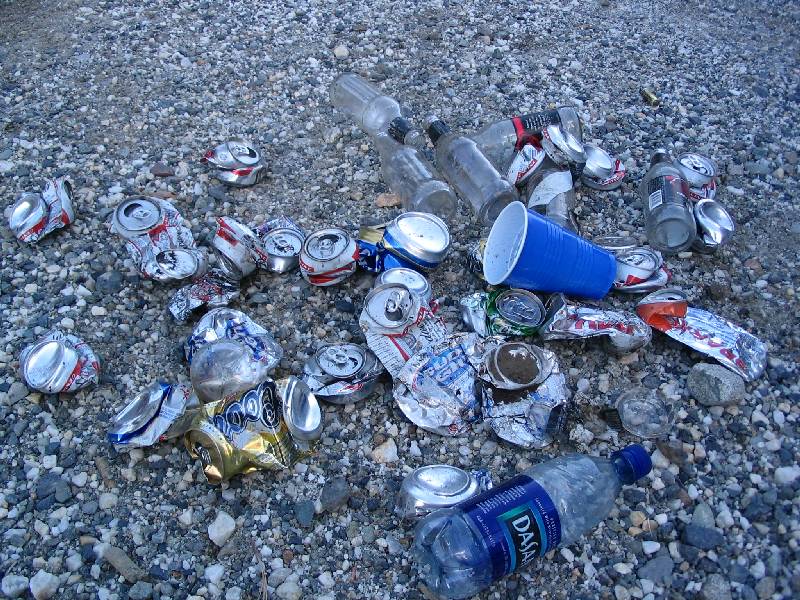
Trash on the Trail - Pick it up!


Anywhere people go, you can find trash that they've left behind; it's unfortunately human nature.  Not everyone who visits our backcountry areas are litterbugs, but it's everyone's responsibility to haul out more than they brought in.  Most responsible 4-wheelers automatically pull over and pick up any trail trash that they happen to come upon.  In fact, it's such an expected behavior that a Trasharoo is found on the back of most trail rigs these days:

My Rubicon Trail Foundation special edition Trasharoo
Accidental littering still happens, and there will always be "bad apples" who leave trash behind, so trail trash will always be a reality.  Unfortunately, trail litter is some of the ammo that the anti-access people use to get public lands closed to everyone but hikers, so we must remain vigilant about keeping our trails clean.  I continue the tradition I was taught as a Boy Scout to always leave any campsite or trail spotless, no matter how messy it might have been before my arrival.  I keep two bags in my Trasharoo (one for recycle materials, the other for trash) and I never pass by any trash I spot in camp or on the trail.

One of my friends recently posted on Pirate4x4 a good lesson to share with kids, litterbugs, and trail-closure people regarding the reality of trail trash.  I've reprinted it here:

Here is my take on the Trail Trash issue, whether it be Rubicon, Fordyce, Slick Rock, Greenhorn, or Johnson Valley:

NO ONE who comes to this forum can claim ignorance. Facts are we have been resting on OUR Laurels. Education never stops. EVER. We all have to continue to pull together to keep the trail clean, in good shape, and functioning.

I had a friend tonight (MC guy) complain to me about his cohorts. How the trails were looking trashed.

I've always said - "It's like being a Mom (or Dad), and mopping the kitchen floor. You scrub that floor, pay particular attention to the corners, under the cabinets, you pull out your good, HD floor cleaner tech and kick some azz on that dirt. You take a moment to stand back and admire your work, it looks clean and sparkly, 10 seconds later the boys come in from outside, spend 5 minutes getting a snack and heading to the living room to play video rock crawling. You turn around after the very brief whirlwind of activity is over, your kitchen floor is TRASHED".

What do you do? Do you go online and air the very same dirty laundry that everyone else in this world experiences, or do you pick up your mop and DO IT AGAIN?

You calmly - with a smile on your face, grateful to have a kitchen floor to mop - pick up your swiffer wet jet and DO IT AGAIN

My point is - even if you spent the time to educate your torrid teens/pre-teens, you're never going to stop needing to MOP THE FLOOR. It needs to be done daily whether you think so or not.

Regular attention needs to be paid to all our trails. ALL OF THEM.

Like I also said to my MC friend, you don't clean/maintain that trail for only yourself, you do it for the dumb jerks who you didn't get to educate, you do it for the criminals, and you do it for the responsible folks. You just do it because YOU want to ride again.

Please let's take the narcissism out of why we do what we do and JUST DO IT.

Jumat, 22 November 2013

AEV Jeep Wrangler Wins the 2013 Australasian Rally


Back in September, Team Lerner Reina and their American Expedition Vehicles-built Jeep Wrangler JK 231R took on one of the toughest endurance motorsport races in the Asia-Pacific region, the Australasian Safari.  Similar to the Baja 1000 and the Dakar Rally, this is one of those races where it's an achievement to even cross the finish line.  Their awesome driving and navigational skills, along with a reliable and capable Jeep, meant an outstanding finish.  Here is a summary of their outstanding performance:

• 100% Safari Finisher - Their AEV Wrangler was the ONLY production vehicle to finish 100% of the Safari
• Fastest Safari Female - Amy Lerner
• Winner Production Class A1.2
• Winner Overall Safari Production - Their AEV Wrangler had the best performance of ANY production vehicle entered in the Safari
• Winner of the Dakar Challenge - This earned Team Lerner Reina an entry spot in the 2014 Dakar Rally


Tricia and Amy are both awesome competitors and fantastic role models.  The capability and durability of the Jeep Wrangler and the AEV suspension is exactly why I chose this combination for my own backcountry adventures.  Check out the video below for footage from the 2013 Australasian Safari.